
Why Instruments Come Before Demolition
The traditional approach to a hidden leak was to start opening walls and floors until the wet spot appeared. That approach works, but it trades one repair for several. A failure found by instruments before any cutting needs one opening, one repair, and one patch. A leak located by demolition requires as many openings as it takes to find the source, plus patching all of them.
The three instruments used in professional leak detection cover different physical properties of a leaking pipe. Acoustic equipment reads sound. A thermal camera reads temperature. Tracer gas equipment reads chemical concentration. Each of those properties behaves differently in different materials and at different depths, which is why a complete detection visit often uses more than one.
Acoustic Detection
A pressurized pipe that loses water through a hole or crack makes sound at that point. The sound travels outward from that point through the pipe itself, through the surrounding material (concrete, soil, or wood framing), and upward toward the surface. An acoustic detector, either a ground microphone or a contact sensor placed against the floor or wall, picks up that sound and amplifies it.
More precise detection uses a correlator. Two sensors go at different points on the pipe, such as fittings on either side of a buried run. The correlator reads the tiny timing difference between when the leak sound hits each sensor. From that timing and the known sensor spacing, it calculates where on the pipe the leak is. Correlation works best on metal pipe, which transmits sound efficiently over long distances.
Acoustic is the normal first step because it covers large areas fast and narrows the search to a pipe section before other tools are needed. Its limits are background noise and pipe materials that absorb sound. PEX and plastic pipe do not carry sound as far as copper or steel. Deep leaks in thick concrete also challenge acoustic methods. That is where thermal imaging adds its value.
Thermal Imaging
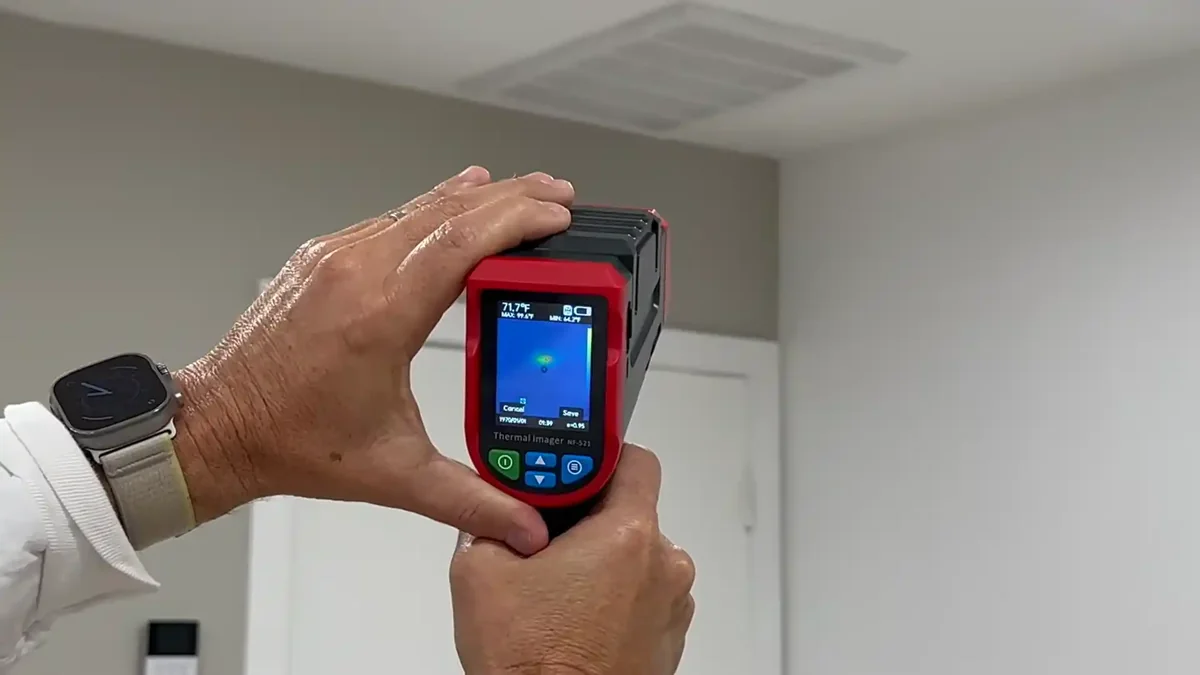
A thermal camera reads surface temperature across its view and shows the result as a color map. A hot-water supply leak warms the soil and material above it. When that heat reaches the concrete or flooring, the camera shows it as a warmer patch against the surrounding surface. A cold-water supply leak can also show, through an evaporative cooling effect that makes the leak zone slightly cooler than its surroundings.
Thermal imaging works through concrete and flooring without any contact. The camera reads the surface of the floor and finds the temperature signature of whatever is happening below. In a South Boulder ranch home with copper under the slab, a first-floor thermal scan often finds the hot-water line failure as a warm oval on an otherwise uniform surface.
Thermal imaging has limits. A deep leak, five or six feet down, may not produce enough surface temperature change to read. A thick or well-insulated slab absorbs the heat before the camera can see it. Those conditions move the detection to tracer gas.
| Method | What It Reads | Best For | Limitation |
|---|---|---|---|
| Acoustic | Sound of water escaping under pressure | Metal pipe, initial search, large areas | Plastic pipe, background noise, deep leaks |
| Thermal imaging | Surface temperature variation | Hot-water slab leaks, wall leaks | Deep leaks, thick slab, cold-water lines |
| Tracer gas | Gas concentration at surface | Any material, precise pinpoint, dry pipes | Requires pipe to be drained first |
| Video camera | Visual inspection of pipe interior | Drain and sewer lines | Supply lines (too small, pressurized) |
Tracer Gas Detection
Tracer gas is the most exact method for finding a buried or enclosed leak. The pipe is drained and then filled with a safe, non-flammable gas mix, typically 95% nitrogen and 5% hydrogen. The gas is lighter than air and escapes at the leak point, rising through the soil, concrete, or framing above the pipe and emerging at the surface above the failure.
A technician sweeps a sensor along the floor or ground above the pipe. It picks up the trace of gas rising from the leak and marks the spot. The gas keeps rising until the pipe is refilled with water, letting the technician run multiple passes to confirm the spot.
Tracer gas works on any pipe material, any depth practical for pipe installation, and even on drain lines that are not under pressure during normal use. It is also effective when acoustic detection has narrowed the leak to a section of pipe but cannot pinpoint the exact spot within that section. The combination of acoustic to narrow and tracer gas to confirm is a reliable sequence for difficult locations.
What a Detection Visit Looks Like in Practice
A standard leak detection visit starts with the meter test to confirm an active pressurized loss and estimate the rate. Then acoustic equipment goes to work along the pipe run most likely to contain the failure, based on where the meter movement stops when different zones are isolated. When acoustic narrows the location to a few feet of pipe, thermal imaging scans the surface above that section. If the failure is on the hot-water side and the thermal signature is clear, the location is marked for repair. If thermal is not conclusive, the pipe is drained and tracer gas is introduced to pinpoint the spot.
The whole process, for a typical slab or buried line leak, takes two to four hours. At the end, the crew marks the leak location to within a few inches and writes a report on the probable cause. The homeowner then decides on repair timing and method. Nothing has been opened. The repair access comes after detection, sized for the actual location of the failure. That is the detection-before-demolition principle in practice.
For any active pressurized leak in a Boulder home, whether you have heard water running, seen the meter move, or received an unexplained bill, call (303) 552-3896. The visit starts with listening, not cutting, and every homeowner in our Downtown Boulder area and across Boulder County gets the same instrument-first sequence.
Frequently Asked Questions
- Does tracer gas damage my pipes or leave any residue?
- No. The gas mixture used for leak detection is non-toxic, non-flammable, and does not react with pipe materials. It dissipates from the soil within hours of the test. The pipe is flushed with water and returned to service after detection. The gas leaves no residue inside or outside the pipe.
- Why do some leak detection companies only use acoustic and not tracer gas?
- Equipment cost and training are the main factors. A tracer gas system requires a higher capital investment and proper handling training compared to acoustic sensors alone. For many common leaks, acoustic and thermal are sufficient and tracer gas is not needed. When a leak is deep, in PEX, or in a drain line, tracer gas becomes the tool that provides a definitive answer.
- Can these tools find a leak without me being home?
- Acoustic and thermal can be used in an unoccupied building with normal access to the utility spaces. Tracer gas requires the water to be shut off and the pipe segment to be drained before injection, which requires access to valves the crew will walk you through. For occupied homes, detection is typically completed in one visit with the homeowner present for the meter test and valve operations. Call (303) 552-3896 to schedule around your availability.
Suspect a hidden leak? Get it found without demolition.
✆ Call (303) 552-3896, 24 Hours