
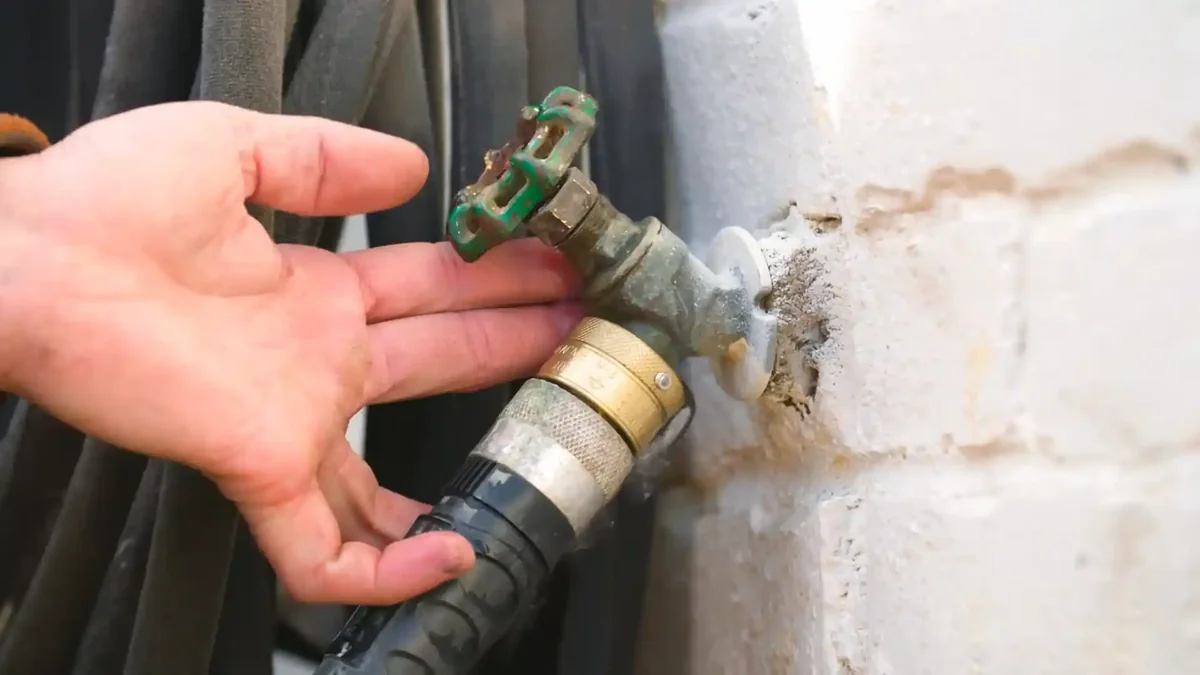
How a Frost-Free Hose Bib Is Supposed to Work
A frost-free hose bib, also called a freezeless bib, has a longer-than-usual stem. When you turn the handle, the actual water shutoff happens twelve inches or more inside the wall, where the pipe is warm enough to avoid freezing. After you turn it off, the water in that long stem drains downward and out through the spout, so nothing is left to freeze.
That drain function is the whole design. And a garden hose blocks it.
Why a Hose Left On Defeats the Entire System
When you leave a hose attached and the weather drops, the water trapped between the bib and the hose end cannot drain. It freezes in the bib body or in the stem inside the wall. The ice expands and splits the brass or the copper tube inside the wall. When the thaw comes, that split pipe runs freely, often directly into the wall cavity, undetected until the drywall is soaked.
This is why early spring calls for water-damaged walls and ceilings in Boulder are so common. The pipe split in December or January. The hose or the bib cap held the water back through the freeze. Then a warm Chinook came through, the hose loosened, and the leak started. In some cases the homeowner does not notice until May when they turn on the outdoor water and the pressure drops to nothing while the wall gets wet.
The Autumn Checklist for Boulder Hose Bibs
The task list is short and takes about fifteen minutes for a typical Boulder house. Do it by mid-October, ahead of the hard freezes rather than after them.
- Remove every garden hose from every exterior bib. Do not leave any attached, including bibs you rarely use.
- Store hoses in a garage or shed where they will not freeze and crack.
- If you have a manual interior shutoff valve that feeds an exterior bib, close it and open the bib to drain the exposed pipe.
- Check for hose spray attachments left screwed onto the bib end; these hold water the same way a hose does and prevent drainage.
- Inspect the bib face for drips or mineral deposits that might indicate it is already weeping.
When to Upgrade to a Frost-Free Bib With a Vacuum Breaker
Boulder homes with irrigation connections and multiple outdoor water points benefit from a certified frost-free bib with a built-in vacuum breaker. The vacuum breaker prevents backflow from the hose into the supply line, and the frost-free stem provides the freeze protection. Together they handle most of the winter risk for an occupied home. For vacation properties and second homes, adding an interior shutoff with a drain-down is a stronger protection layer.
Our hose bib repair and replacement service upgrades older standard bibs to frost-free models and handles the split-stem repairs that happen after a freeze event. We also inspect the wall cavity where the bib enters the house, because water that runs inside a wall cavity in January may not surface until spring.
The Bib the Frost-Free Rating Does Not Cover
One more thing worth knowing. A frost-free bib is rated frost-free when it is installed correctly and the hose is removed. It is not frost-free when installed on a wall that has no interior heat, like a detached garage or a shed with uninsulated walls. In those locations the shutoff valve sits in freezing air, not heated space, and the frost-free protection does not work. Those bibs need an interior ball valve shutoff that you close and drain each fall. It is a quick install and it is the only protection that actually holds in an unheated building.
Outdoor steps in Boulder homes also sometimes have a freeze exposure point: the area around the bib where the line passes through the rim joist. If that zone is not insulated, cold air reaches the line regardless of the bib type. A short section of foam pipe wrap and a gap-seal around the entry point fixes the problem in thirty minutes and prevents the split that costs thirty times more to fix.
What to Do If You Think a Bib Already Froze
If you turn on an outdoor faucet in spring and get low or no pressure, the bib may have split inside the wall during the winter. Do not run the water. Close the interior shutoff if you have one, or close the house main. Then call for a frozen pipe inspection. The crack may be in the bib body, which is a simple swap, or in the copper supply tube inside the wall, which requires locating the water before opening drywall.
In Boulder and the surrounding 80302 ZIP code neighborhoods where older homes have standard bibs rather than frost-free models, this is a routine spring call. We find it, confirm where the water went, and fix the right thing without exploratory demolition. Call (303) 552-3896 when you are ready.
Frequently Asked Questions
- Are all hose bibs in Boulder frost-free?
- No. Homes built before the mid-1980s typically have standard compression-style bibs without the long frost-free stem. These bibs must have their interior shutoff valves closed manually every fall and the exterior bib opened to drain. Many homeowners do not know these shutoffs exist or where they are. If your home predates 1985, check with a plumber.
- A hose bib drips even when I'm not using it. Is that a freeze issue or something else?
- Possibly something else. A drip at the bib face when the hose is off usually means a worn rubber washer, a simple fix. A bib that weeps from the stem or seeps around the handle may have internal freeze damage. Turn off the interior shutoff, remove the handle, and look at the packing nut and stem. A cracked or distorted stem means replacing the whole bib. Call (303) 552-3896 if unsure.
- How cold does it have to get in Boulder for a hose bib to freeze?
- A single night below 28°F is enough for an exposed bib with a hose attached. Boulder's average low in December and January runs around 20°F. The canyon areas, Nederland, Lyons, and Eldorado Springs, run colder and stay frozen longer. Any outdoor pipe with standing water is at risk below freezing, regardless of whether frost-free hardware is installed.
Suspect a hidden leak? Get it found without demolition.
✆ Call (303) 552-3896, 24 Hours