
Boulder's Water: The Softness That Surprises People
Boulder's drinking water comes from Barker Reservoir, Silver Lake and Lakewood watershed, and Boulder Reservoir fed by the Colorado-Big Thompson project. All of those sources deliver mountain snowmelt, low in dissolved minerals by definition. The Betasso and Boulder Reservoir water treatment plants run a Corrosion Control Program using lime and carbon dioxide to nudge the chemistry toward neutral. The result is water that measures about 2.4 grains per gallon, one of the softest municipal supplies in the Front Range network.
That is good news for your fixtures, your water heater, and your appliances. Scale does not build up. Soaps lather easily. Showerheads stay clear. But it is harder news for the copper pipe itself, particularly pipe that is old enough to have seen some service. Soft, low-mineral water is slightly corrosive to copper. It lacks the mineral buffer that slows the electrochemical reaction at the pipe wall, and over decades, that reaction eats inward from the inside surface and creates pinholes.
How a Pinhole Actually Forms
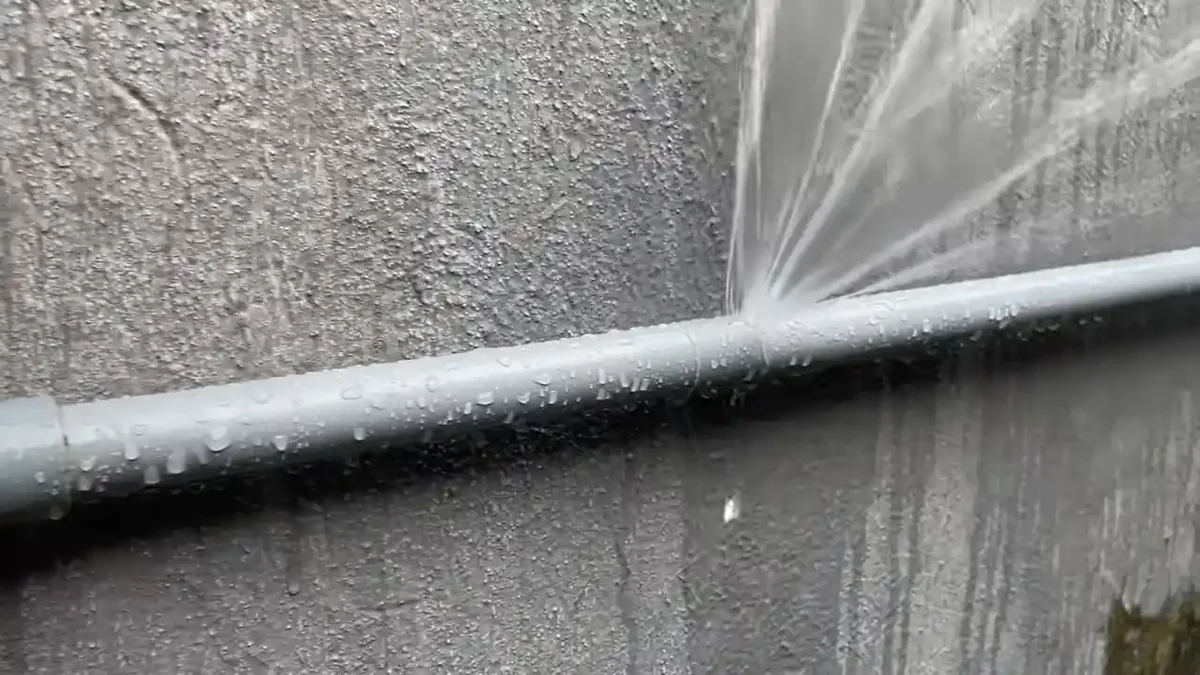
Copper pipe corrodes from the inside through a process called pitting corrosion. It is not uniform thinning. It is localized attack at specific points where the pipe wall is weakest or where turbulence concentrates flow. Water moving at high speed through a fitting or elbow carries minerals in the flow that scrape the pipe's inner lining. Where pitting starts, a tiny pit deepens rather than spreads. Over years, it eats through the pipe wall and creates a pinhole that ranges from a tiny weep to a spray under pressure.
In hard-water areas, dissolved calcium often deposits in those pits and slows them down. Boulder's soft water does not carry that buffer. The pits progress more freely. This is why Boulder's pre-1980 copper pipe has a meaningful pinhole history while newer copper and PEX in the same buildings does not.
Why the First Pinhole Is a Signal, Not Just a Problem
Many homeowners treat the first pinhole as a one-off, patch it, and move on. That works if the pipe is young. For a pipe that has been in service forty or fifty years, the first pinhole is evidence of a pipe-wide condition, not a single failure. The same chemistry that ate through at that spot has been working at every fitting, every elbow, and every long run throughout the house. Some are six months from failing. Some are three years. None of them show their hand until they do.
The right response to a first pinhole in copper that is older than about 1980 is not a patch. It is an inspection. Pull the section that failed and look at the inside of the pipe. A smooth interior with a single pit is a single-point failure. A rough interior with visible pit fields means the pipe is on a timeline you cannot outrun with patches. That interior view is the most honest data available, and it costs nothing beyond the repair itself.
What Boulder Homes Are Most at Risk
The neighborhoods at highest risk are those built between roughly 1945 and 1980. That means the mid-century ranches in East Boulder and South Boulder, the post-war homes in Mapleton Hill and Table Mesa, and the older cottages in the Downtown core. These homes have copper supply lines that are now between forty-five and eighty years old, in soft water that has been working on them the whole time.
Pre-war galvanized supply in the oldest buildings carries a different failure mode, corrosion from outside and scale buildup that closes the bore, and it deserves its own assessment. But the copper era homes, broadly 1950 through 1980, are the ones where Boulder's soft-water pinhole pattern shows up most reliably in our service calls.
Options When Pinholes Start
The choice between repair and full repipe depends on the pipe's interior condition, the failure location, and how many failures the house has already had. For a first pinhole in pipe that looks clean inside, a section repair with modern copper or PEX plus a watchful eye is reasonable. For pit fields throughout or a second pinhole within a year, the math on a repipe usually wins. A repipe is a one-time cost versus an indefinite series of leak calls, drywall patches, and potential water damage on the occasions the leak goes undetected.
Our pinhole leak detection and repair service always includes a look at the failed section's interior, and we will tell you what we see plainly. For a mid-century Boulder home with original copper, that assessment is the most useful information you can have. Call (303) 552-3896 and let the pipe tell its own story.
Frequently Asked Questions
- Why does Boulder have so many pinhole leaks compared to other Colorado cities?
- Boulder's mountain-source water is very soft, around 2.4 grains per gallon, which means it lacks the dissolved minerals that buffer copper pipe from inside corrosion. Harder-water cities see more scale buildup, which ironically protects pipe walls. Boulder homeowners with pre-1980 copper get the opposite: clean, soft, slightly aggressive water working on aging pipe walls for decades. The result is a higher pinhole rate in that era's housing stock.
- We just had a pinhole fixed. Do we need to worry about the rest of the house?
- Possibly. The right question is what the interior of the removed pipe section looked like. Smooth interior with a single pit means watch and wait. A rough interior with pit fields throughout means the pipe condition is widespread, and another failure is a matter of when, not if. Ask your plumber to describe what the pulled section showed, or ask us for a second look.
- Is PEX safe from this same problem?
- Yes. PEX is not subject to the electrochemical corrosion that attacks copper. Pinholes are a copper-specific failure mode caused by the reaction between soft water and the pipe wall. Homes with PEX supply lines, built after about 1990, do not share this risk. For a pinhole in older copper, call (303) 552-3896.
Suspect a hidden leak? Get it found without demolition.
✆ Call (303) 552-3896, 24 Hours